
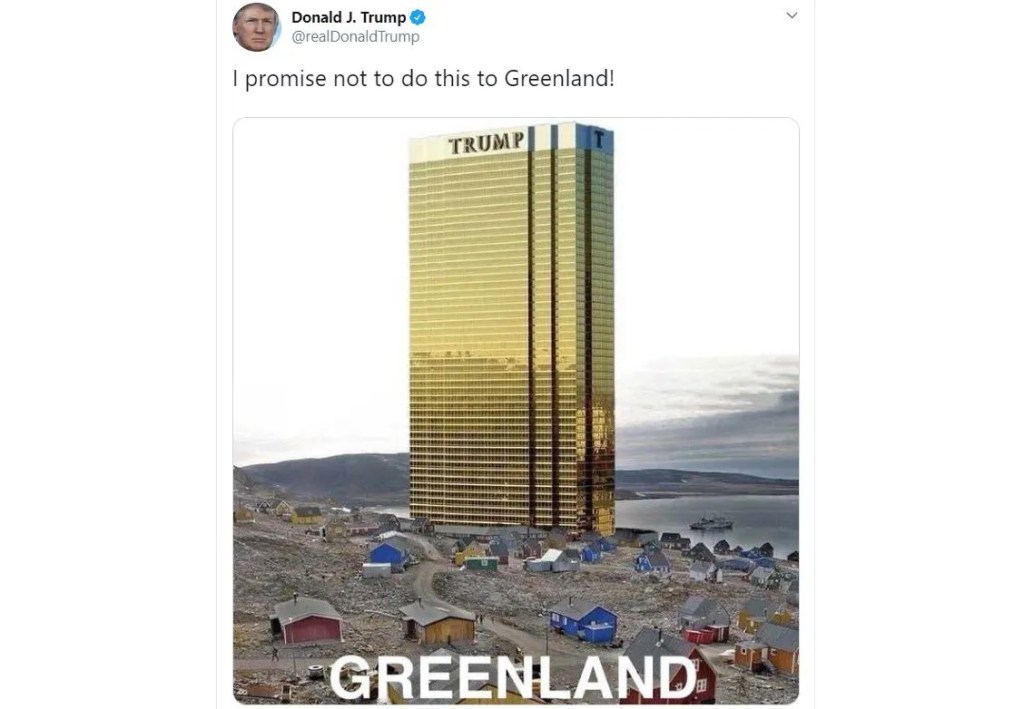
One of Donald Trump’s Twitter posts on 20 August 2019.
Donald Trump has recently been suggesting a US acquisition of Greenland. He made similar overtures during his first term back in 2019, and other US officials discussed the idea in 1867, 1910, and 1946, with the administration of Harry Truman actually offering Denmark $100 million.
Greenland’s legal status has undergone fundamental changes over the last century, beginning with its full incorporation into the Kingdom of Denmark in 1953. After Home Rule referenda in 1979 and 2008, it is now a largely self-governing territory, albeit with Denmark maintaining control over defence and monetary policy as well as some aspects of diplomacy.
A US purchase (or hostile takeover) of Greenland sounds absurd — and, more importantly, it would cut against the democratic wishes of the majority of Greenlanders for greater self-government or even independence — but it would also be consistent with America’s growing cultural and religious influence in the territory. The Arctic in general has begun to attract more aggressive religious expansionism in recent decades, much of it emanating from the United States,1 including groups affiliated with US conservative evangelicalism.2
US-based religious movements like Jehovah’s Witnesses and the Seventh-day Adventists have evangelised in Greenland for over seventy years with varying levels of success, and today Baptist, evangelical, and Pentecostal missions are multiplying quickly as part of a broader heightening of interest in the Arctic among Western religious leaders. Initially, most of these groups relied on Danish missionaries to carry out this work, but in the twenty-first century they are increasingly sending Americans.
Greenland’s modern colonial history begins in 1721 when Hans Egede, a Norwegian-Danish missionary, landed on the western coast and set about spreading Christianity to the Inuit people. From that moment until 1953, Greenland was subject to a Lutheran ecclesiastical monopoly governed by the Royal Mission College in Copenhagen.
Nevertheless, in the twentieth century Greenland’s links with the ‘great wide world’ began to diversify beyond those imposed by Danish colonisation, beginning in earnest in the early 1940s after Denmark surrendered to Nazi Germany. The Danish authorities left on the island permitted the US to set up a military base in Greenland’s Arctic north. Despite the efforts of the colonial authorities to limit their interactions with outsiders, Inuit Greenlanders suddenly had opportunities to meet some of the thousands of US service-people travelling to and from Thule Air Base (TAB), established in 1943.3 The diverse range of religious services offered at the base was a point of curiosity to the Greenlandic media.4
Another key change occurred in 1953 when Denmark’s new postwar Constitution phased out Greenland’s colonial status and abolished the ecclesiastical monopoly.5 The Lutheran Church could no longer exclude the many competitors who were eagerly waiting at the gates.
Most of the new arrivals were Danish or other Scandinavian missionaries representing either US-founded groups or denominations with strong links to the Americas. Swedish Pentecostals, for instance, were among the first to take advantage of Greenland’s opening, arriving just weeks after the new Constitution took force.6 Nearly all Pentecostal missionaries who preached in Greenland in the twentieth century were from the Nordic countries, with only a few coming from the United States and Canada in the 1980s.7
Seventh-day Adventists also arrived in 1953,8 followed by Jehovah’s Witnesses in 1955.9 The Adventist congregation initially experienced healthy growth but declined precipitously in the 1980s, leading to the sale of the group’s Nuuk headquarters in 1998.10 Meanwhile, the Witnesses successfully grew their community (partly aided by Danish Witness migration) and at their height had congregations in seven settlements.11 There are currently around 150 Witnesses in Greenland.12
Missionary groups sometimes carried an intensely negative view of the Inuit people. Early Adventist publications, for example, referred to the Greenlanders as ‘little, dwarfed, oil-drinking, fish-eating bipeds’,13 inferior even to their maligned relatives in Alaska.14 Derogatory notions about the backwardness of the Inuit were implicitly contrasted with the advanced status of Western societies. The Witnesses conducted their evangelism in the 1950s and 1960s with the help of films documenting the work of their faith in America and featuring many beautiful shots of skyscrapers, planes, trains, huge printing presses, and other symbols of American modernity.15 At the same time, though, the missionaries often saw themselves as a line of defence standing between the purity and innocence of the Greenlanders and the moral hazards of that same modernity.16
Though Danish-led, these initiatives introduced distinctly American forms of belief and worship into the Greenlandic faith ecosystem, helping to pave the way for later initiatives that would cut out the Danish middle-man, so to speak.
Catholicism returned to Greenland after a 500-year absence when American priest Michael Wolfe landed in Nuuk in 1960, having originally intended to undertake a field chaplain role at Thule Air Base.17 He lived in a small Jamesway hut (a portable housing solution used by the US military) while he oversaw the construction of a Catholic chapel in the city,18 handing over responsibility for the congregation to the Inuit Greenlander Finn Lynge in the mid-1960s.19 Americans and Canadians also played leading roles in the introduction of the Bahá’í Faith to Greenland.20
Many other American religious groups tried to enter Greenland’s increasingly busy spiritual marketplace in the twentieth century, including the Church of Scientology, a New Religious Movement based in Clearwater, Florida which attempted to sell its literature to Greenlanders in the 1980s.21 In 1990, Assemblies of God preachers Jack and Betty Bransford travelled from their congregation in Alaska to speak at an evangelical and Pentecostal conference in Kangaamiut and to participate in public preaching activities.22 A small group of Mormons met in Nuuk from 1998 to 2014 and there was briefly an official missionary presence.23
In 2000, many of Greenland’s evangelical and Pentecostal missions came together to form New Life Church/Inuunerup Nutaap Oqaluffia (INO). With worship practices that would be very familiar to any American charismatic evangelical, INO soon became Greenland’s second-largest Christian organisation after the Lutheran Church of Greenland, boasting over 500 members.24 INO is politically very closely aligned with US conservative evangelicalism, having made its opposition to same-sex marriage a key distinguishing feature in its public positioning.25 It has fostered close ties with other Inuit-majority evangelical groups in Nunavut, Canada, and has been visited by several American evangelical preachers and worship groups, including the Celebrant Singers.26

The Catholic congregation also continues to be a hub of international connections. Prominent US Catholic Cardinal Theodore McCarrick visited Greenland in 2007 to attend an interfaith conference on climate change,27 and it is not just US-American influence that is increasing. In 2009, responsibility for the congregation in Nuuk was transferred to Latin American priests of the Institute of the Incarnate Word / Instituto del Verbo Encarnado (IVE). This has opened up new cultural connections with Catholic communities in Central and South America and has prompted a number of Spanish-speaking Catholics to visit Nuuk.28
One of the most noteworthy changes in the twenty-first century has been the creation of Greenland’s first Baptist church in Ilulissat. Its founder, Chris Shull, an Independent Baptist from Maryland, USA, arrived in 2007 with sponsorship from the All Points Baptist Mission organisation in Ohio, which specialises in the Arctic region. He was drawn to Greenland precisely because he wanted to go ‘somewhere where there weren’t too many Baptist missionaries’, and he told journalist Julia Duin that being an American in Greenland ‘opens doors’ as many people there are curious about America. Shull avoids Pentecostal styles of worship because he believes, in Duin’s words, that they too closely resemble an Inuit shamanic tradition that still ‘lurks in the culture’.29
Christian Hedegaard, born in Denmark but now senior pastor of the evangelical Powerhouse Church in Orlando, Florida, has also conducted mission trips to Greenland, starting in 2003 with a trip to Kullorsuaq in the northwest on the invitation of a local schoolteacher who had read one of his books, Conquering Demons.30 One Greenlandic woman kept in touch with him and visited Orlando for religious classes at Hedegaard’s church.31
Even previously-unsuccessful denominations are returning to try again. A new Seventh-day Adventist mission led by a Kenyan-American couple and directed by Adventist Frontier Missions (based in Michigan) got under way in Nuuk in 2024.32
These developments are all components in a wider pivot in Greenland’s world connections away from the east (in this case Europe) and towards the west (the Americas), powered in part by external cultural pressures and in part by simple geographic and economic factors.
The overall statistical impact of the incursions by American religious groups is not particularly impressive — a 2022 US Department of State report found that 93% of Greenlanders are still members of the Lutheran Church of Greenland33 — but their true significance is that they represent the thin end of a cultural wedge. Greenland has arguably never been in the news cycle as much as it is now. Climate change, the geopolitical struggle for the Arctic, the island’s rich natural resources, and the blustering imperialism of Donald Trump will ensure it remains near the top of the agenda in years to come, and this will only attract more US evangelism.
American religious ambitions and American political ambitions may begin to act symbiotically. The more social and cultural connections are forged between Greenland and the United States, the more Trump and other hawkish politicians will be emboldened to claim that Greenland falls within the rightful sphere of influence of the USA. But in a world governed by principles of self-determination (which is admittedly an ideal more than a reality), the only sphere of influence into which Greenland falls belongs neither to the USA nor to Denmark, but to the Greenlanders themselves.
Notes
- J. Duin, ‘Jehovah’s Witnesses, Sikhs, Muslims: New religious groups race to Arctic’, Newsweek Magazine, 20 November 2022. https://www.newsweek.com/2022/11/25/jehovahs-witnesses-sikhs-muslims-new-religious-groups-race-arctic-1759921.html ↩︎
- F. B. Laugrand and J. Oosten, Inuit shamanism and Christianity: Transitions and transformations in the twentieth century (Montreal: McGill-Queen’s University Press, 2010), p. 344. ↩︎
- E. Beukel, ‘Greenland and Denmark before 1945’, in E. Beukel, F. P. Jensen, and J. E. Rytter (eds.), Phasing out the colonial status of Greenland, 1945–54 (Copenhagen: Museum Tusculanum Press, 2010), pp. 29–32. ↩︎
- ‘THULE — et stykke Amerika i Grønland’, Atuagagdliutit/Grønlandsposten, vol. 93, no. 21, 8 November 1953, pp. 394–5. https://timarit.is/page/3777348 ↩︎
- A. K. Sørensen, Denmark-Greenland in the twentieth century (Copenhagen: Museum Tusculanum Press, 2007), pp. 108–10. ↩︎
- S. Öberg, Pingst i Grönland: En studie av den grönländska frikyrkan, Inuunerup Nutaap Oqaluffia (Uppsala: Institutet för Pentekostala Studier, 2010), p. 12. ↩︎
- Ibid., pp. 13–16. ↩︎
- ‘The Advent message in Greenland’, Northern Light, vol. 3, no. 9, September 1953, p. 1. https://documents.adventistarchives.org/Periodicals/NL/NL19530901-V03-09.pdf ↩︎
- Watch Tower Society, 1993 Yearbook of Jehovah’s Witnesses (New York: Watch Tower Bible & Tract Society, 1993), pp. 115–18. ↩︎
- N. Johansson, S. H. Jensen, and J. E. Pedersen, ‘Greenland mission’, Encyclopedia of Seventh-day Adventists, 26 January 2021. https://encyclopedia.adventist.org/article?id=CCS5#fn19 ↩︎
- ‘Jehovas vidner til kongres’, Atuagagdliutit/Grønlandsposten, vol. 119, no. 37, 13 September 1979, p. 3. https://timarit.is/page/3801502 ↩︎
- F. A. J. Nielsen, ‘Religion and religious communities’, Trap Greenland, 2021. https://trap.gl/en/kultur/religion-og-trossamfund/ ↩︎
- G. W. A., ‘Read and profit’, The Health Reformer, vol. 2, no. 5, November 1867, p. 73. https://documents.adventistarchives.org/Periodicals/HR/HR18671101-V02-05.pdf ↩︎
- ‘The Esquimaux of Alaska’, The Health Reformer, vol. 12, no. 11, November 1877, p. 334. https://documents.adventistarchives.org/Periodicals/HR/HR18771101-V12-11.pdf ↩︎
- J. Lind, ‘Farvefilm’, Atuagagdliutit/Grønlandsposten, vol. 102, no. 7, 29 March 1962, p. 17. https://timarit.is/page/3782862 ↩︎
- Watch Tower Society, 1967 Yearbook of Jehovah’s Witnesses (New York: Watch Tower Bible & Tract Society, 1967), p. 130. ↩︎
- K. Kjærgaard, ‘Mellem sekulariseret modernisme og bibelsk fromhed: Fromhedsbilleder og moderne kirkekunst i Grønland 1945–2008’, Fortid og Nutid, June 2009, no. 2, p. 110. https://tidsskrift.dk/fortidognutid/article/view/75443 ↩︎
- ‘Katolsk kirkebygning står færdig i Godthåb til marts’, Atuagagdliutit/Grønlandsposten, vol. 102, no. 22, 22 October 1962, p. 13. https://timarit.is/page/3783299 ↩︎
- ‘Hjem til Grønland’, Atuagagdliutit/Grønlandsposten, vol. 105, no. 19, 16 September 1965, p. 10. https://timarit.is/page/3785696 ↩︎
- C. Linfoot, ‘Convention Report — 1950’, Bahá’í News, no. 232, 25 April 1950, p. 4. https://bahai.works/Bah%C3%A1%E2%80%99%C3%AD_News/Issue_232 ; N. G. R. Tinnion, ‘John Aldham Robarts, Knight of Baháʼu’lláh, 1901–1991’, The Bahá’í World vol. 20, 1986–1992 (Haifa: Bahá’í World Centre, 1998), pp. 803–4. https://bahai.works/Bah%C3%A1%E2%80%99%C3%AD_World/Volume_20 ↩︎
- ‘Vær i stand til at være dig selv!’, Atuagagdliutit/Grønlandsposten, vol. 124, no. 10, 7 March 1984, p. 29. https://timarit.is/page/3811573 ; ‘Kort om Dianetik’, Atuagagdliutit/Grønlandsposten, vol. 129, no. 18, 15 February 1989, p. 4. https://timarit.is/page/3822103 ↩︎
- ‘Kristumiut aasarsiortut’, Atuagagdliutit/Grønlandsposten, vol. 130, no. 96, 22 August 1990, p. 16. https://timarit.is/page/3826665 ↩︎
- M. Martinich, ‘Prospective LDS outreach in Greenland and the Faroe Islands’, Cumorah, 29 July 2015. https://www.cumorah.com/articles/caseStudies/6/453/prospective-lds-outreach-in-greenland-and-the-faroe-island ↩︎
- ‘Grønlands frikirke i Sverige’, Sermitsiaq, 24 May 2009. https://www.sermitsiaq.ag/samfund/gronlands-frikirke-i-sverige/547600 ↩︎
- I. S. Rasmussen, ‘Chefredaktøren anbefaler: Mit gode liv i Nuuk’, Sermitsiaq, 24 August 2018. https://www.sermitsiaq.ag/samfund/chefredaktoren-anbefaler-mit-gode-liv-i-nuuk/576748 ↩︎
- Öberg, Pingst i Grönland, pp. 26–33. ↩︎
- ‘Cardinal McCarrick urges rescuing planet’, Zenit, 9 December 2007. https://web.archive.org/web/20120927020624/http://www.zenit.org/article-20485?l=english (archived from the original). ↩︎
- P. F. Schilereff, ‘“The heart of the mission” (IVE in Greenland)’, Chronicles IVE, 2 May 2013. https://www.instituteoftheincarnateword.org/the-heart-of-the-mission-ive-in-greenland/ ↩︎
- J. Duin, ‘The pastor at the top of the world’, Newsweek, 20 October 2021. https://www.newsweek.com/pastor-top-world-1640942
↩︎ - C. Hedegaard, ‘Bringing healing to Greenland’, Evangelist Ministries International, 1 November 2018. https://evangelistministries.international/2018/11/01/bringing-healing-to-greenland/ ↩︎
- K. Hedegaard, ‘Send out as a missionary to her own people’, Evangelist Ministries International, 1 August 2019. https://evangelistministries.international/tag/greenland/ ↩︎
- J. Nyamwange and B. Nyamwange, ‘A shelter in the time of storm’, Adventist Frontier Missions, 1 August 2024. https://afmonline.org/post/a-shelter-in-the-time-of-storm ↩︎
- United States Office of International Religious Freedom, ‘Report on International Religious Freedom: Denmark’, US Department of State, 2022. https://www.state.gov/reports/2022-report-on-international-religious-freedom/denmark/ ↩︎
 Religion in Greenland