

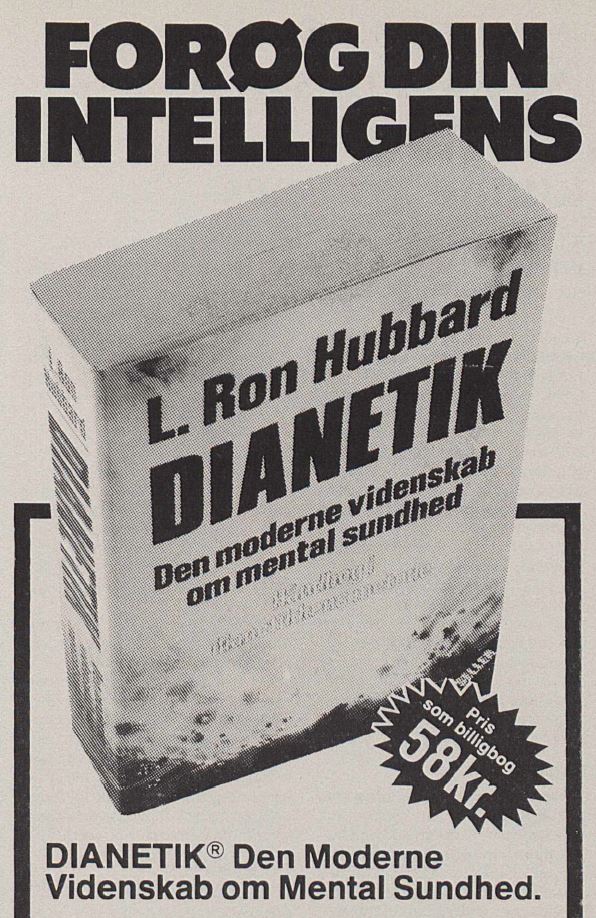
Graphic from a Scientology advertisement in the Greenlandic press.
The Church of Scientology was founded in 1953 by L. Ron Hubbard, a pulp fiction writer turned psycho-spiritual guru who amassed a loyal following after the publication of his book Dianetics: The Modern Science of Mental Health in 1950. Though he at first claimed only to be concerned with the mind, Hubbard quickly pivoted in his writings to spiritual matters, particularly the human soul, which he called a ‘thetan’, and the prospect of unlocking supernatural powers.1 As expressed by the Church’s current leader David Miscavige, Scientology’s fundamental promise is that it can ‘help the able become more able’.2
Scientology has, at best, a very distant relationship with Greenland. It is not and has never been physically active on the island, and if it is mentioned at all in Greenlandic discourse it is usually to highlight in a general sense the many challenges that traditional Christian denominations face from sects and new age movements, not to raise the alarm about a specific threat to the Lutheran Church in Greenland.3
Hubbard and the ‘Eskimos’
L. Ron Hubbard had a very low estimation of Inuit society. In one of his short stories from 1935, titled Yukon Madness, he describes ‘Eskimo’ characters as having ‘slanted eyes’, ‘black stringy hair’, and ‘greasy’ faces. Inuit culture is depicted only with reference to baseless stereotypes, such as the notion that all Inuit live in igloos or that Inuit women are routinely traded and stolen like property. When the main character, an officer of the Canadian Mounted Police, is attacked by a murderous Inuit man named Itauk after being caught in the company of his potential spouse, Hubbard opines: ‘Had they [the people of the village] been other than Eskimos they would have thought instantly that Itauk was revenging himself upon the Mountie for the taking of Itauk’s woman-to-be. But neither they nor Itauk could consider this a crime.’
The main character’s Inuit love interest, called Kaja, is only permitted to be beautiful because she appears ‘half-white’. As Hubbard explains: ‘Her face was not that of an ordinary Eskimo woman. It was finer, more delicate. Nor were the eyes slanted.’4

Hubbard’s preconceptions about the ‘Eskimos’ also surfaced in bizarre fashion in his non-fiction writing. In Dianetics: The Modern Science of Mental Health, he raises a hypothetical scenario in which a person undergoing ‘auditing’, the Dianetics equivalent of counselling, claims to be troubled by a traumatic vision in which ‘Mama is having intercourse with five Eskimos’.5 In the text, this serves as an example of something that the ‘auditor’, or counsellor, would likely suspect to be a fabrication, but it also suggests that in Hubbard’s mind Inuit people were exotic, almost fantastical beings who lacked Western sexual sensibilities.
These notions did not stem from any real-world experience on Hubbard’s part – his only genuine interaction with the northern lands came in 1940 with a boat trip along the Pacific coast of Canada and the Alaskan panhandle that reached Ketchikan (55° North), a city in Tlingit ancestral territory. He called it the Alaskan Radio-Experimental Expedition and sailed under the flag of the Explorers Club, but he spent most of his time ashore acting as a local radio host.6 He claimed that he had once been in command of a US Navy ship near the Aleutian Islands of Alaska during the Second World War when a polar bear climbed aboard and attacked the crew. This has no basis in truth.7
‘Something unusual’: The 1980s push
It is not surprising, given this background, that Hubbard was not particularly interested in selling his new religion to the Inuit peoples. However, the Church of Scientology did undertake a limited Danish-language publicity campaign for its literature in the bilingual Greenlandic newspaper Atuagagdliutit / Grønlandsposten (A/G) in the mid-to-late 1980s. This coincided with a worldwide effort to get Hubbard’s Scientology books back on the best-seller lists after they slumped in the 1970s.8
One advertisement placed on 7 March 1984 promoted the Danish version of L. Ron Hubbard’s book Self Analysis, promising that readers ‘who dare to embark on something unusual’ would be able to ‘find’ themselves and improve their self-confidence, memory, thinking abilities, and concentration, leading to ‘a more relaxed and natural relationship’ with their surroundings.

By diligently working through the book’s methods, the text exclaimed, one would ‘feel noticeable results after a short time’. Copies were available to purchase in what was then the country’s only book retailer, the Atuagkat Bookstore in Nuuk (est. 1966), while postal orders were directed to the Church’s publishing house in Copenhagen.9
Another advertisement one week later promoted the book Dianetics, wherein one could allegedly find ‘a way in which any healthy person can achieve a significant increase in thinking ability and intelligence’.10 A personal story testifying to the book’s effectiveness (written by Lotte Stahl Hemmingsholt, probably from Denmark) was placed in the 15 August 1984 issue.11
One more wave of advertisements came early in 1989, this time featuring quotes in praise of Dianetics from two prominent Frenchmen, the philosopher Denis Huisman and the physician Paul Chauchard. The advertisement also bore the Atuagkat Bookstore’s logo and directed all enquiries to the store’s address.12 It ran for three issues, ending in March 1989.13 With this, Scientology’s brief promotional push into Greenland came to a close.

Notes
- H. B. Urban, The Church of Scientology: A history of a new religion (Oxford: Princeton University Press, 2011), pp. 42-70. ↩︎
- ‘Scientology leader David Miscavige: First-ever network TV interview’, World Religion News, 30 April 2015. https://www.worldreligionnews.com/religion-news/scientology/first-ever-network-tv-interview-with-scientology-leader-david-miscavige/ ↩︎
- J. Johansen, ‘Udfordring til kirken’, Atuagagdliutit/Grønlandsposten, vol. 122, no. 19, 12 May 1982, p. 42. https://timarit.is/page/3806967 ↩︎
- L. R. Hubbard, Yukon madness (Hollywood: Galaxy Press, 2008), pp. 1-22. ↩︎
- L. R. Hubbard, Dianetics: The modern science of mental health (New York: Hermitage House, 1950), p. 396. (Page 473 in the 2007 edition.) ↩︎
- R. Miller, Bare-faced messiah: The true story of L. Ron Hubbard (London: Silvertail Books, 2015), pp. 91-4. ↩︎
- Ibid., p. 119. ↩︎
- M. Davis, ‘Selling Scientology’, Portland Mercury, 7 August 2008. https://www.portlandmercury.com/news/2008/08/07/862344/selling-scientology ↩︎
- ‘Vær i stand til at være dig selv!’, Atuagagdliutit/Grønlandsposten, vol. 124, no. 10, 7 March 1984, p. 29. https://timarit.is/page/3811573 ↩︎
- ‘Forøg din intelligens’, Atuagagdliutit/Grønlandsposten, vol. 124, no. 11, 14 March 1984, p. 11. https://timarit.is/page/3811596 ↩︎
- ‘Forøg din intelligens’, Atuagagdliutit/Grønlandsposten, vol. 124, no. 33, 15 August 1984, p. 4. https://timarit.is/page/3812686 ↩︎
- ‘Kort om Dianetik’, Atuagagdliutit/Grønlandsposten, vol. 129, no. 18, 15 February 1989, p. 4. https://timarit.is/page/3822103 ↩︎
- ‘Kort om Dianetik’, Atuagagdliutit/Grønlandsposten, vol. 129, no. 24, 1 March 1989, p. 5. https://timarit.is/page/3822247 ↩︎
 Religion in Greenland